If you ride, you already know a flat tire is a different animal on two wheels than it is in a car. There’s no spare bolted to the trunk floor and no hazard lights to lean on while you wait for help — just you, a slowly deflating tire, and a decision to make before it gets dangerous. A tire pressure monitoring system (TPMS) takes the guesswork out of that decision by watching your tire pressure in real time and warning you the moment something’s off, often before you’d ever feel it in the handling.
We’ve rounded up five of the best motorcycle TPMS units on the market right now, covering everything from premium Bluetooth systems to simple no-app standalone displays. As always, we verify current availability and pricing on Amazon before publishing, so what you see below reflects what’s actually in stock today.
What to Look for in a Motorcycle TPMS
Before diving into the picks, a few things worth knowing:
- Bluetooth app vs. standalone display: App-connected systems (like FOBO and Hyphoon) send alerts straight to your phone and often log ride history. Standalone units (like the OBEST or Sykik) show pressure on their own screen — no phone required, which some riders prefer for simplicity and battery life.
- Valve stem compatibility: Most external sensors thread onto the valve stem and work best with metal valve stems. If your bike has rubber/snap-in stems, check the manufacturer’s guidance before installing, since added weight and torque can matter more on rubber stems.
- Waterproofing: Look for an IP67 rating at minimum — your sensors live outside, exposed to rain, road spray, and heat off the engine.
- Battery life and type: Coin-cell sensors (CR1632, CR1225) typically last 6–12 months and are simple to swap. Rechargeable sensors save on replacement batteries but need periodic USB charging.
1. FOBO Bike 2 TPMS — Best Overall
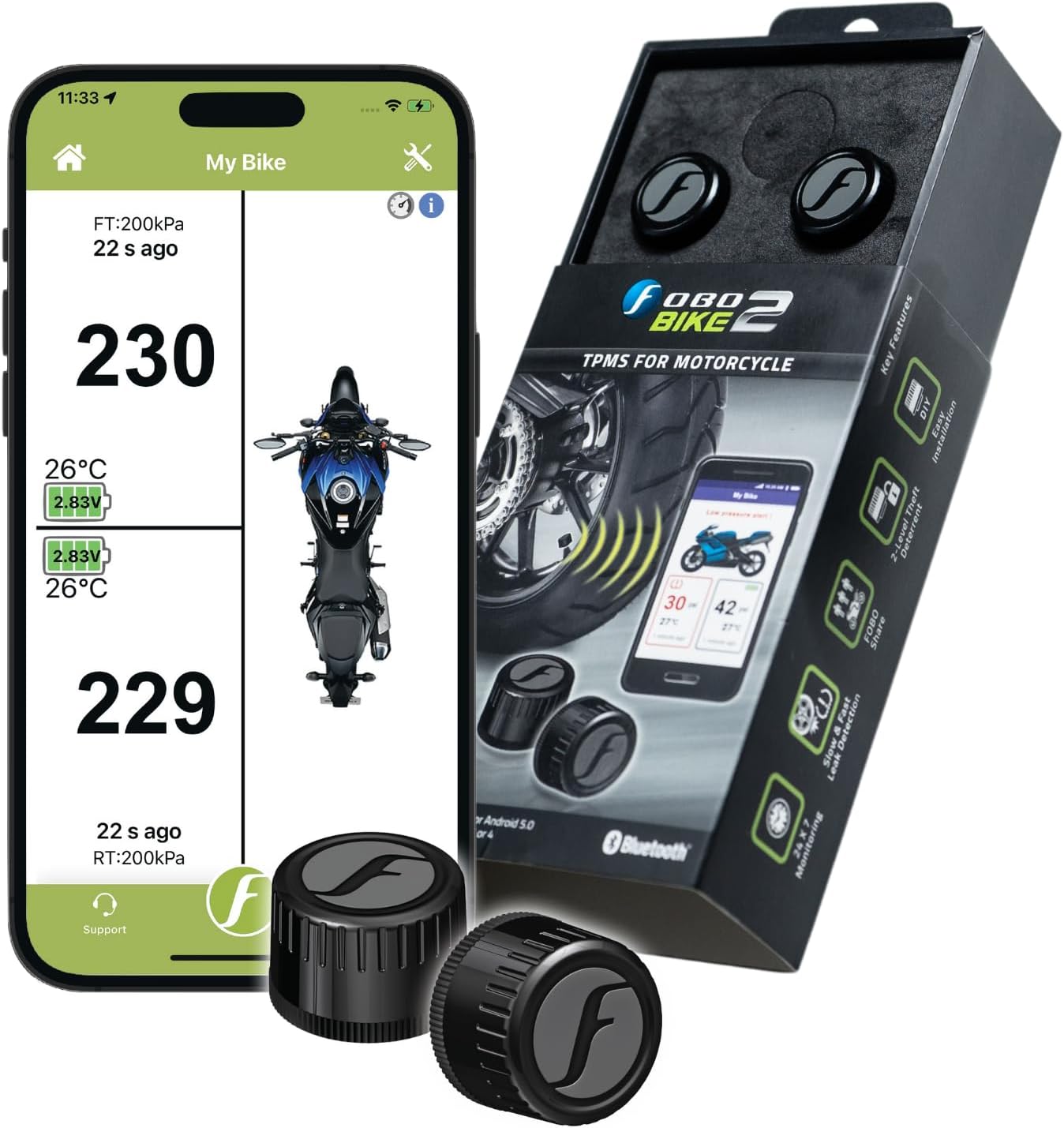
The FOBO Bike 2 is the most refined option on this list. It runs on Bluetooth 5.0 and pairs directly with your phone — no separate receiver unit required — giving you real-time pressure and temperature readings plus slow-leak and fast-leak detection sent straight to your phone, smartwatch, or Bluetooth headset. Installation is genuinely DIY: thread the sensors onto your valve stems, pair the app, and you’re monitoring within minutes.
A nice touch for security-conscious riders: each sensor is tied to your FOBO account after installation, and the kit includes anti-theft lock-nuts with a special wrench, so a stolen sensor has no resale value to a thief.
Pros: Real-time app monitoring, no separate receiver needed, anti-theft locking sensors, waterproof (IP57), lightweight (7.6g per sensor)
Cons: Premium price point; requires a smartphone for full functionality
Check Current Price on Amazon →
2. KEMIMOTO Motorcycle TPMS System — Best for Multiple Bikes
If you own more than one bike — or ride with a group — the KEMIMOTO stands out for its app that supports monitoring up to 50 vehicles at once, each with its own KEMIMOTO TPMS installed. It runs on a stable Bluetooth 5.2 connection and carries an IP67 rating rated for -40°C to 85°C, so it holds up whether you’re commuting through a downpour or riding through dust on a trail.
Pros: Multi-vehicle dashboard in one app, strong IP67 waterproofing, wide operating temperature range, long sensor battery life
Cons: Overkill if you only own one bike; app-dependent
Check Current Price on Amazon →
3. OBEST Upgrade Motorcycle TPMS — Best Budget / No-App Pick
The OBEST skips the smartphone entirely. It comes with its own 1.5-inch waterproof LCD monitor that displays pressure and temperature for both tires directly, along with a clock and vehicle inclinometer. The sensors are USB rechargeable rather than coin-cell, so there’s no battery to buy — just plug in periodically. It’s IP67 rated and includes anti-theft nuts, a mounting bracket, and the wrench needed for installation.
Pros: No phone or app required, rechargeable sensors, budget-friendly, bright LCD readable in daylight or at night
Cons: No remote/phone alerts, so you only see readings when looking at the mounted display
Check Current Price on Amazon →
4. Sykik Rider SRTP300 — Best for Reliability
Sykik’s SRTP300 uses radio wave transmission rather than Bluetooth, which the company positions as more stable and less prone to dropouts than app-based systems — a fair trade-off if you don’t need phone integration. The 1.5-inch monitor lets you set separate pressure thresholds for front and rear wheels, and sensors run on replaceable CR1225 batteries good for roughly a year. It’s backed by a one-year US warranty with California-based customer support, which matters if something goes wrong down the line.
Pros: Stable radio-wave connection (no Bluetooth dropouts), separate front/rear threshold settings, US-based warranty and support, simple setup
Cons: Best suited to metal valve stems; no app or smartphone integration
Check Current Price on Amazon →
5. Hyphoon Motorcycle TPMS — Best Lightweight Pick
The Hyphoon’s biggest selling point is how little it adds to your bike. Each sensor weighs just 0.35 oz, low enough that it shouldn’t meaningfully affect wheel balance the way some bulkier sensors can. It’s Bluetooth-based with real-time pressure and temperature alerts sent to your phone, a default BAR reading with easy switching to PSI, and a one-tap “full exit” feature in the app to stop background battery drain when you don’t need monitoring running.
Pros: Extremely lightweight sensors, minimal impact on wheel balance, easy screw-on install, app available on both iOS and Android app stores
Cons: Bluetooth range and reliability depend on phone proximity
Check Current Price on Amazon →
Which One Should You Get?
If you want the smoothest experience and don’t mind paying for it, the FOBO Bike 2 is the safest recommendation — it’s the most polished system here and the anti-theft design is a genuine plus. If you’re outfitting more than one motorcycle, the KEMIMOTO multi-vehicle app is hard to beat. Riders who’d rather not depend on a phone at all should look at the OBEST or Sykik SRTP300, and anyone chasing the lightest possible setup should lean toward the Hyphoon.
Whichever you choose, pair it with good maintenance habits — check out our guide to the best GPS trackers for motorcycles if bike security is also on your radar, or our best dash cams for cars roundup if you’re outfitting more than just the bike.
Frequently Asked Questions
Do I need a TPMS if my motorcycle didn’t come with one?
Most motorcycles, unlike modern cars, don’t include a factory TPMS. Since you can’t glance down and see a spare tire waiting in the trunk, an aftermarket TPMS is one of the cheaper safety upgrades you can make, especially for touring or long-distance riders.
Will an external sensor work with my valve stems?
External sensors thread onto standard Schrader valves and are generally designed for metal valve stems. If your bike uses rubber/snap-in stems, check the specific product’s guidance, as the added weight and torque from the sensor can stress a rubber stem over time.
How long do TPMS sensor batteries last?
Coin-cell powered sensors (CR1632 or CR1225) typically last 6–12 months depending on use, and are simple to replace yourself. Rechargeable sensors avoid the battery cost but need a USB top-up every few weeks to months.
Disclosure: This post contains affiliate links. As an Amazon Associate, Helmet and Wheel earns from qualifying purchases at no extra cost to you. See our Affiliate Disclosure for details.